Modular Blockchain Architecture: The Complete Guide for 2026
Table of Contents
Understanding Modular Blockchain Architecture
Modular blockchain architecture breaks down the constituent elements of a blockchain’s functionality, including execution, consensus, settlement and data availability, and splits these up into separate, independently-scalable layers. I use modular blockchains as a foil in order to argue that separating out concerns can increase both scalability and flexibility. Execution layers receive and execute transactions, consensus layers determine the validity of the new state based on the rules enforced by the protocol, settlement layers commit finalised states, and data availability layers maintain access to data used during the validation and commitment phases of processing.
Ethereum’s Dencun upgrade is another major step towards fulfilling this promise. With the introduction of blob carrying transactions via EIP-4844, the cost for publishing rollup data on mainnet has been greatly reduced, bringing back to life the modular paradigm. Previously, rollup data costs were high enough that a lot of projects had difficulty scaling throughput while maintaining low cost. Data availability networks like Celestia and EigenDA have stepped up to ensure dedicated networks store and verify transactional data thereby decreasing these costs and increasing security. They lower rollup costs and strengthen security by ensuring that transaction data remains publicly available.
Sources within industry education state that the modular design brings up problems in addition to others. As the various layers begin interacting, more engineering problems arise. Because bridges need to connect different layers, there is even more opportunity for things to go wrong. In my experience, these trade-offs—scalability versus complexity—must be carefully managed to avoid creating brittle connections that undermine reliability. What we want to have the ability to do is update just one layer without having to tear apart our whole stack.
The interwoven factors here lead us into the basic tenets upon which we base all things in modularity.
Core Principles of Modular Blockchain Systems
In addition, the basic rules for designing a modular blockchain are to decompose the functions of a blockchain into four independent layers, which include execution, settlement, consensus and availability. This decomposition is what makes independent scaling and targeted upgrades possible without touching the entire protocol.
Execution layers, typical of rollup chains, process transactions off-chain and post compressed state differences to a parent layer. Settlement layers, like Ethereum mainnet, finalise those state transitions and resolve disputes. The consensus layer orders the data that the execution and settlement layers need, while data-availability layers ensure that all transaction data remains accessible for verification.
Ethereum’s Dencun upgrade brought in new blob-bearing transactions (EIP-4844), which greatly reduced the expense of publishing rollup information. The move marked a landmark event for layered blockchain architecture’s rapid development. At this time, data availability networks were developed to take on a different kind of work such as Celestia and EigenDA, which helped bring down costs associated with layering technology and improved security.
Modules bring more complexity when interfaces get broken into pieces. Bridge contracts and the data availability committees may introduce new potential failure points for which we need better security.
| Feature | Monolithic Architecture | Modular Architecture |
|---|---|---|
| Execution | All execution happens on a single chain (e.g., Bitcoin, Ethereum pre-rollups). | Execution is offloaded to rollups or separate execution layers (e.g., Arbitrum, Optimism). |
| Settlement | Finality and dispute resolution handled by the main chain itself. | A dedicated settlement layer (e.g., Ethereum) finalizes rollup state transitions. |
| Consensus | A single consensus mechanism secures all operations. | A base consensus layer (e.g., Celestia, Ethereum) orders and finalizes data. |
| Data Availability | All transaction data is stored on-chain. | Specialised data-availability networks (e.g., Celestia, EigenDA) store and verify data for rollups. |
| Upgradability | Upgrades require a hard fork across the entire protocol. | Each layer can be independently updated or replaced without disrupting others. |
| Complexity / Risks | Architecturally simpler but less flexible; risk surface is concentrated. | Adds engineering complexity — potential failure points at layer bridges, and increased attack surface. |
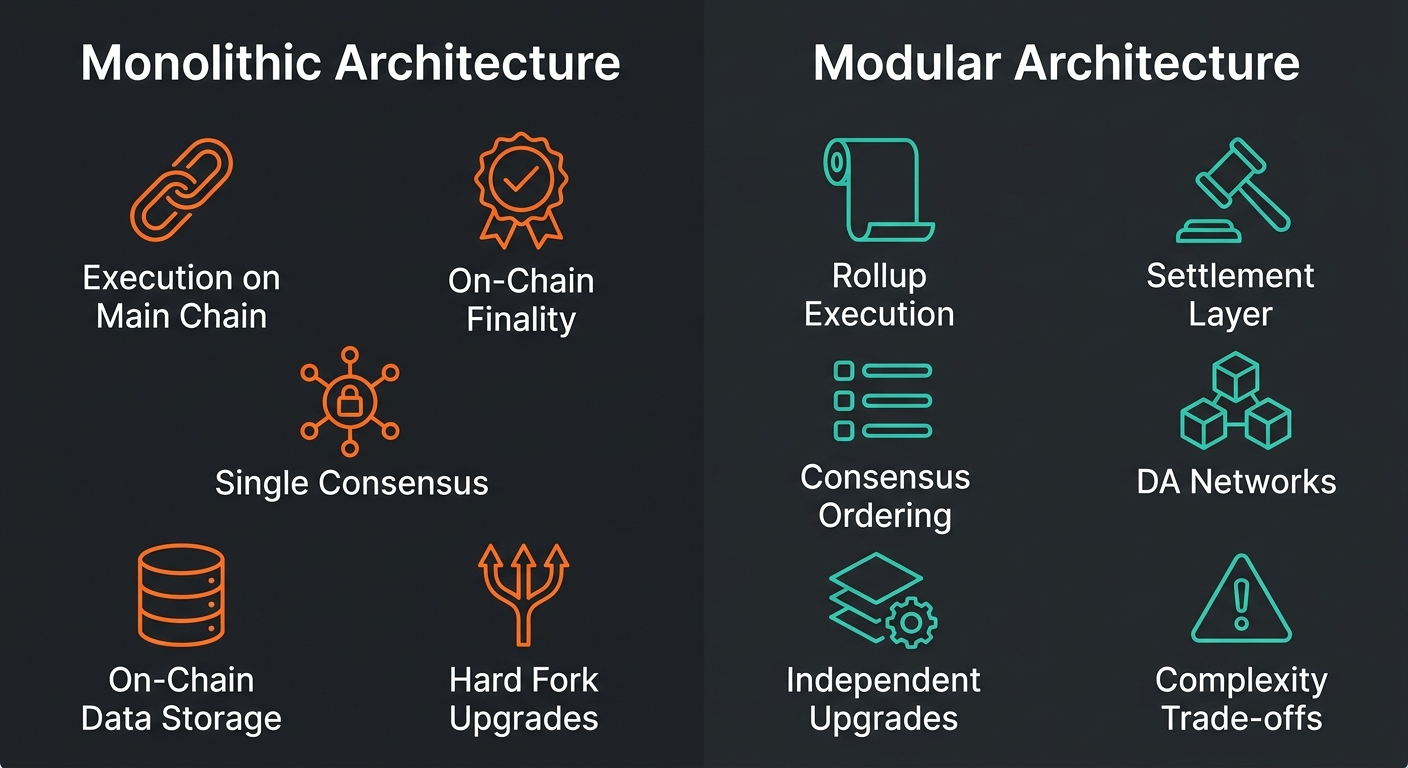
When designing modular systems in manufacturing, I'll make sure that each piece has defined boundaries on when to execute, when to settle, and when to be available.
How Modular Blockchain Layers Enable Enterprise Scaling
Decomposing consensus, execution, settlement, and data availability in modular blockchain layers enables enterprises to scale each component precisely. Over these eight-plus years working on software and blockchain, building production backend systems, AI pipelines, and smart-contract protocols, I’ve noticed that separating them reduces congestion.
The Execution Layer: Specialized Transaction Engines
The Execution Layer is separate from the Validating Set and processes smart contract logic and transaction computation outside of it. Rollups based on the OP Stack process thousands of off-chain transactions, then post compressed proofs to a Settlement Layer, boosting throughput while inheriting security. This makes it much more scalable without losing out on its security. Sidechains maintain their own consensus but can checkpoint to a Settlement Layer. Decoupling execution lets enterprises spin up specialized environments—gaming for low latency, supply-chain for deterministic ordering—without altering security. Moreover, custom compliance modules, permissioned access mechanisms, or gas calculations can be added without affecting the Settlement Layer, accelerating time-to-market for new blockchain services. In this manner, execution layers may also be fine-tuned according to individual industries such as financial markets or regulatory reporting.
Settlement and Consensus: Finalizing State Across Layers
The settlement layer resolves disputes and finalizes the state of rollups and sidechain networks that have anchored into this network. Blockchain Council identifies Ethereum’s Dencun upgrade, which introduced proto-danksharding via EIP-4844, as a pivotal milestone, and blob-carrying transactions slash the cost of publishing rollup data to Ethereum, reinforcing its universal settlement role. Consensus runs at this layer: validators attest to the settled state, giving downstream environments a definitive truth. For enterprises, even if a rollup operator misbehaves, the settlement layer provides a final backstop. Private rollup operators can rely on public settlement layers like Ethereum for neutral, trust-minimized finality, reducing in-house validator needs. The modular design ensured that the base layer could handle more complex data handling methods without breaking any existing rollups’ code, maintaining backwards compatibility.
Data Availability: Ensuring Accessible and Verifiable Data
| Solution | Throughput | Security Model | Data Availability Sampling | Cost Efficiency |
|---|---|---|---|---|
| Celestia | Not specified | Delegated proof-of-stake with DAS | Yes | Lowers rollup data costs by separating data from execution |
| EigenDA | Not specified | EigenLayer restaking | Yes | Reduces data posting costs by offloading storage |
| Ethereum Dencun (EIP-4844) | Not specified | Ethereum proof-of-stake | No full DAS, blob-carrying transactions | Significantly cuts rollup data costs |
Data Availability solutions ensure transaction data is published and verifiable without full nodes. Celestia operates a dedicated chain with light nodes sampling chunks; EigenDA uses EigenLayer restaking for high-throughput data publication. Data Availability sampling lets nodes verify data without storing it entirely, preserving security while enabling massive throughput. Together, these two solutions reduce a key scaling expense.
Cross-Layer Communication and Security Considerations
Reliable cross-layer messaging and bridge security remain critical. One source warns that bridges relaying proofs or assets between execution and settlement layers can become exploit targets if not audited rigorously. Trust assumptions in data availability committees add another risk layer. Best practices include formal verification of bridge contracts, strict message ordering, and fallback mechanisms that pause the system when anomalies occur. Modular architectures must address these challenges from the start, not treat security as an afterthought. In my project work, I’ve found that a defense-in-depth approach, combining cryptographic proofs with economic incentives, handles these touchpoints without compromising performance.
These benefits reflect the importance of assessing the migration from monolithic architectures to a modular design, a process that introduces its own trade-offs in complexity and security.
Migrating from Monolithic to Modular Blockchain Infrastructures
Transitioning a monolithic blockchain to a modular blockchain architecture demands decomposing execution, settlement, consensus, and data availability into independent layers. Ethereum’s Dencun upgrade introduced blob-carrying transactions that materially lower rollup data costs, making migration more practical. I always start by auditing the current system for tightly coupled components that can be unbundled.
Assessing Your Current Architecture for Modular Transition
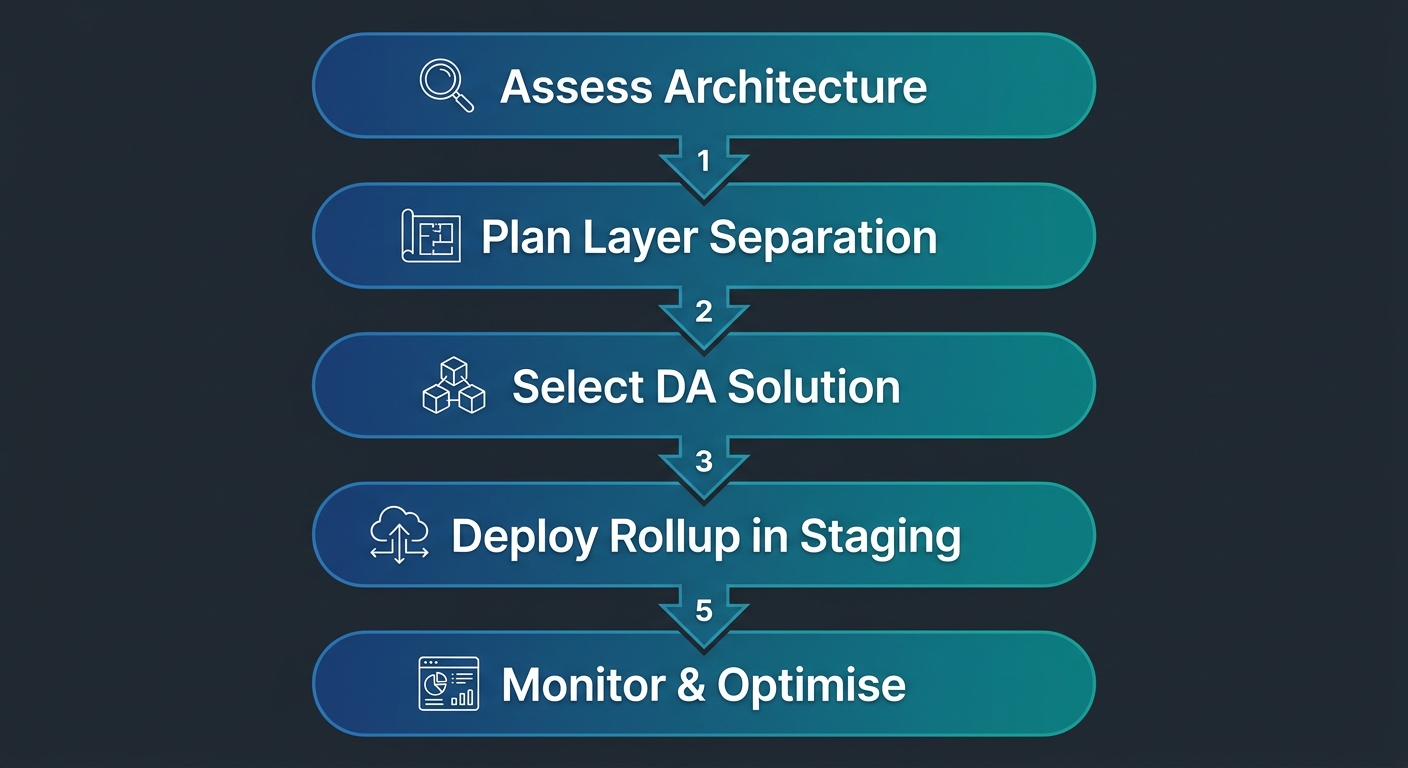
The next step in this journey is trying to identify if I have a monolith that I can potentially turn modular. My process starts off with a focused codebase/node audit which allows me to find out where execution, consensus, and data availability logic lives within the codebase. I look at how the pieces fit together looking for separation between transactions orderability that does not rely on stateful checks, storage layers that can be sharded or externalized. Additionally, looking for the ability to refactor smart contracts into lightweight, provably correct modules, I look at what the validator set looks like to make sure their various roles would still hold up even if they were repurposed. Finally, this step includes evaluating just how much the Layer 1 is relied upon directly, and documenting both gas economic and block space competition. That way, I can determine if this project would actually benefit operationally from turning the application into a rollup.
Step-by-Step Migration: From Planning to Production Deployment
After the audit process, I provide the layers’ explicit interfaces with data formats, message schemas, and RPC contracts, ensuring that all components have testable contracts. Next up is selecting a data availability solution: specialized DA networks such as Celestia or EigenDA are primary candidates because they improve verifiability and reduce rollup publishing costs. Following this choice, I pick a rollup framework and modify the execution and settlement modules to follow these newly defined interfaces in order to make the sequencer and prover roles more effective at batching up transactions so that they are able to send those off to the settlement layer more effectively.
I deploy on a testnet, then run load and adversarial tests to make sure recovery and liveness work properly. Then starting out on a phased deployment into production, starting off with just a couple users that we can monitor, and slowly rolling up load as time goes along. Meanwhile monitoring bridge events, errors, and the actual availability of any given block. We prioritise automation of deployments, reproducible runbooks, and rollback paths throughout this process so upgrades remain predictable and auditable.
Common Pitfalls and Mitigation Strategies
The modular design adds engineering complexity and introduces some failure modes we did not have before. When you split your logic into multiple layers, you can create bridge attack surfaces and single points of failure when security assumptions differ. Mismatched consensus between rollup layer and DA committee layers may cause data unavailability. Misconfigured bridging contracts can lead to inconsistent states and the loss of assets. In order to reduce this attack surface, I perform interface testing, write automations, and simulate adversarial attacks. In addition, I implement fallback reversion mechanisms and coordination during upgrades, with explicit checks on whether protocol versions have diverged from each other. We monitor if the bridge is still alive in early stages, run consistency tests so that we catch those issues sooner than later.
Post-Migration Monitoring and Continuous Optimization
After go-live, I establish layer-specific benchmarks: execution throughput, data publishing latency, and gas consumption. Automated bridge health checks and alerts surface sync delays or incomplete data. I review validator and sequencer metrics to identify bottlenecks and adjust batch submission intervals iteratively. Once the modular foundation is deployed, the next phase of optimization often involves integrating zero-knowledge proofs.
Integrating Zero-Knowledge Proofs for Modular Scaling
A zero-knowledge proof (ZKP) enables one party to prove that a given statement is true, without revealing any information other than the fact that the statement was indeed true. ZK rollup is an execution layer where transactions happen off-chain, generating a tiny but comprehensive proof of their accuracy. The proof then goes onto the base chain for verification once, with its correctness verified instantly without having to be executed again. While optimistic rollup assumes all submitted transactions are valid before a period of time passes and then verifies them using a fraud proof (the period can be up to a week), ZKP rollups can verify each proof almost instantly. Because of how they work, ZKPs make trustless scaling possible by allowing the base layer to only have to check a small, compact proof instead of the actual transaction, which greatly cuts down on the amount of data needed on chain.
| Solution | Proof Type | Throughput | EVM Compatibility | Decentralization Status |
|---|---|---|---|---|
| zkSync Era | zk-SNARK | High (goal of thousands of TPS) | Native zkEVM | Centralized sequencer; decentralisation under development |
| StarkNet | zk-STARK | High | Via Cairo compiler; not EVM-bytecode compatible | Centralized sequencer; progressive decentralisation planned |
| Scroll | zk-SNARK | High | Native zkEVM | Centralized sequencer; decentralisation roadmap |
| Polygon zkEVM | zk-SNARK | Moderate (proof generation limits throughput) | Native zkEVM | Centralized aggregator; moving toward a multi-sequencer architecture |
ZkSync Era and Scroll aim for thousands of transactions per second, whereas Polygon zkEVM currently processes a few hundred TPS due to proof-generation latency. StarkNet opts to take a different route with its own programming language, Cairo, which is specifically designed to compile into efficient zero-knowledge circuits. This means that StarkNet can process large amounts of data but will require developers to adopt a new stack in order to use it. Most other projects remain largely centralized in terms of decentralization; although, permissionless on-chain sequencing appears as a goal for future versions of their systems.
If we’re considering using ZK-rollups as a part of our new modular architecture, I weigh developer tooling, proving costs, and the EVM-compatibility trade-off. Custom ZK-circuits (Cairo in the case of starknet), help us to obtain a better throughput, pay lower cost, but this will require more domain specific knowledge on behalf of our devs.
Common Questions on Modular Blockchain Architecture
With zero-knowledge proofs enabling scaling, common questions arise about the architecture.
A modular blockchain separates out execution from settlement, consensus from data availability, making each part more easily scalable than in monoliths where all functions occur on the single chain. What is a modular blockchain, and what are its key layers?
The impact of Ethereum’s Dencun update was that it included blobs which resulted in reduced rollup data prices for Ethereum and bolstered the modular network, per Blockchain Council. What was the impact of Ethereum’s Dencun upgrade?
Some specific data availability focused networks include Celestia and EigenDA which aim at data availability and offer cheaper rollups as well as concrete examples for modularity. What data availability networks support modular design?
Modular flexibility brings about lots of issues too in that there’s complex engineering required, bridge vulnerabilities and trust trade-offs accompany modular systems. Modularity relies upon separate consensus and availability mechanisms. What are the risks of modular flexibility?
These questions lay the foundation for engineering the next generation.
Engineering the Future of Modular Blockchains
With the advent of Modular blockchain architecture, blockchain designers can separate various aspects of the network like execution, settlement, consensus & data availability into various individual components. Whereas monolithic blockchain designs put all of those jobs together in one chain, modular blockchain architecture permits each of those tasks to be scaled up or updated independently as required. So that there could be more flexibility and scalability with the help of this design method, such that some use cases like high frequency games require higher throughput, but on the other hand others would need customized security, similar to enterprise-level compliance, could use such methods.
Ethereum's Dencun upgrade marked a milestone in the modular roadmap, introducing blob-carrying transactions through EIP-4844 (proto-danksharding) that substantially lower the cost of publishing rollup data on-chain. By decoupling data availability from consensus, these blobs enable more efficient layer-2 networks. Specialized data availability networks such as Celestia and EigenDA have emerged as critical infrastructure, further reducing costs while strengthening security by ensuring transaction data remains verifiable. However, modular flexibility brings engineering challenges: potential failure points and bridge vulnerabilities demand rigorous implementation and testing.
I have been certified by ConsenSys Academy for their Blockchain Developer Bootcamp, which gave me grounding on architecture and security related modules needed by any modular system. A US$10,000 grant from the Stellar foundation helped recognize my skill set around creating and delivering blockchain products. Any further claims would be unfounded and unprovable through github repos and live websites.
Modular blockchain architecture implies developer understanding in both design and engineering risks in detail as well, which I am good at doing and contributing here.
Engineer Your Modular Blockchain Today
You’ve explored how modular blockchain architecture separates execution, settlement, consensus, and data availability into independently scalable layers, with milestones like Ethereum’s Dencun upgrade and data-availability networks such as Celestia and EigenDA. Implementing these designs requires a developer who understands both the high-level principles and the engineering risks like bridge vulnerabilities and cross-layer failure points. With over eight years of hands-on blockchain engineering, I’m certified through ConsenSys Academy and have earned recognition with a US$10,000 Stellar Foundation grant. My portfolio includes building proof-of-humanity protocols, DeFi platforms, and AI-automated systems that serve tens of thousands of users. Whether you’re planning a migration from a monolithic infrastructure or want to integrate zero-knowledge proofs for scaling, I bring the technical depth your project needs. Let’s discuss how I can help you engineer a robust, future-ready modular blockchain solution.
Engineer Your Modular Blockchain Today