Best Real-World Asset Tokenization Infrastructure: 2026 Comparison
Table of Contents
Real-World Asset Tokenization Infrastructure Landscape
A real-world asset tokenization infrastructure encompasses the technological and regulatory stack that enables the issuance, trading, and management of tokenized real-world assets.
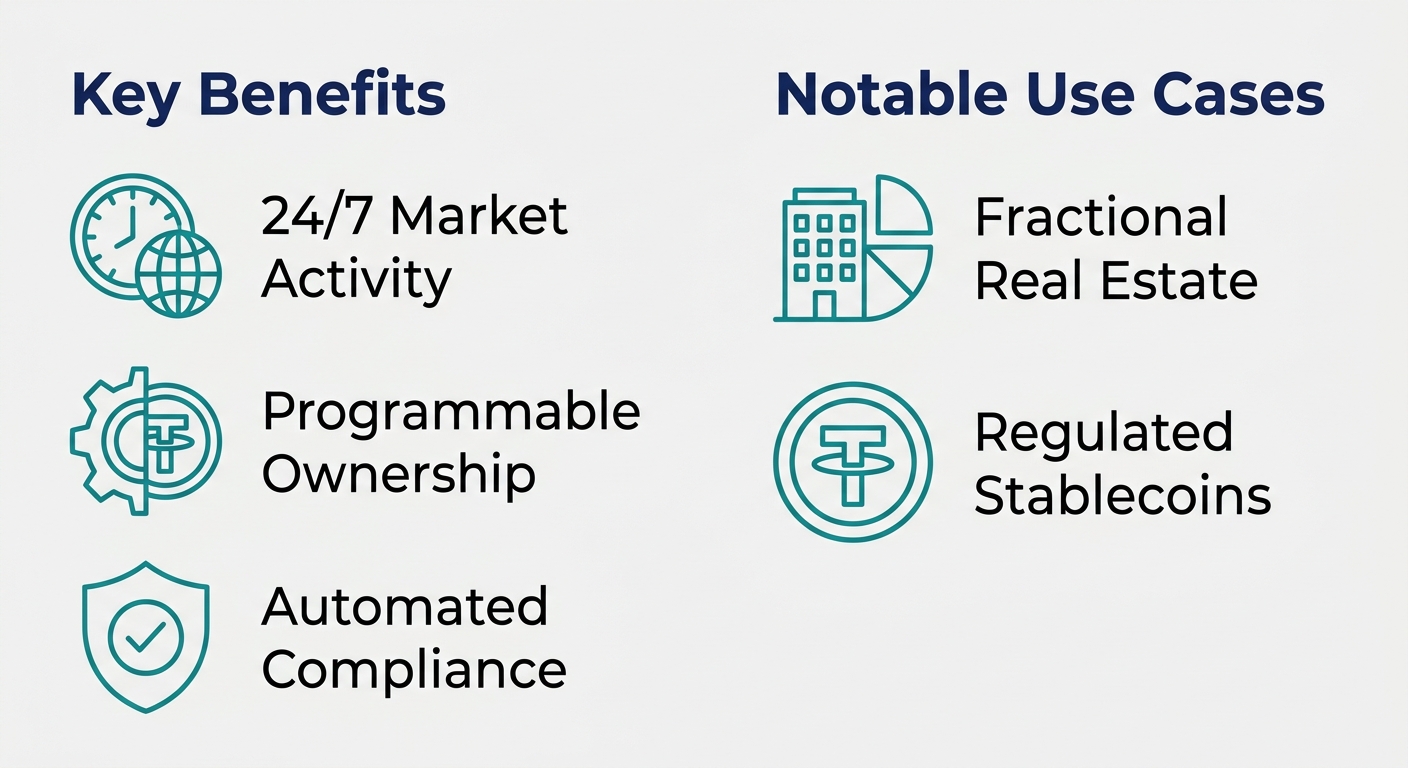
International Association for Trusted Blockchain Applications (INATBA) states that tokenization would enable perpetual market activity on a 24/7 basis, programmable ownership structures, automation of compliance processes using decentralized ledgers. Harmonized, technology-neutral standards are necessary to prevent fragmentation in different countries, for example in the EU under MiCa and the DLT Pilot Regime, and in the UK and Liechtenstein. Report also introduces the Tokenized Micro Flat Tax model. Fractional real estate platforms and regulated stablecoin ecosystems are examples of how the infrastructure might be used in practice.
As the lead developer, I observed that Ethereum has been the backbone of most of these token protocols, allowing assets to be tokenized and interacted with securely.
Ethereum Mainnet
Decentralized blockchain networks can enable the programmable ownership of real-world assets, and Ethereum mainnet remains the most established platform for such tokenization.
Overview
Ethereum is a decentralised blockchain that introduced general-purpose smart contracts, creating a foundation for the tokenisation of real-world assets. The vast DeFi ecosystem and composable protocols make Ethereum the de facto platform for issuing on-chain securities, real estate fractions, and many other types of financial products.
Features
Ethereum’s Turing-complete execution environment, wide adoption, and battle-tested libraries like OpenZeppelin and frameworks like Hardhat provide a robust toolkit for asset tokenization. I build the whole stack: the contracts, the service, the app, and the pipeline that ships it. That hands-on experience confirms that the ERC-20, ERC-721 and ERC-3643 token standards, combined with composable DeFi protocols, enable sophisticated permissioned securities and liquid secondary markets.
Pricing
The gas fees for Ethereum Mainnet differ based on both network conditions and the intricacies of specific smart contracts. Although the INATBA tokenization study places importance on the issue of costs, sudden jumps in expense that occur due to congestion can complicate exact planning.
Pros & Cons
The platform’s stake consensus mechanism and the largest validator sets deliver unrivaled security, as highlighted in a report's focus on institutional-grade security. High gas costs and low throughput limit scalability, while finality at around 13 mins and strict audit criteria add additional layers of complexity, especially when dealing with compliant money market fund tokenization.
Best For
Ethereum mainnet is well suited for high-value tokenization projects that require strong security, can integrate with other projects, and have access to DeFi features. This makes sense for companies that want to deploy their own auditable smart contracts and integrate closely with both lending platforms and exchanges.
Stellar Network
Unlike general-purpose smart-contract environments, Stellar has a ledger which was designed specifically for transferring funds, settling accounts, and issuing on-chain assets directly.
Overview
Stellar enables issuing tokens that represent real-world assets directly on the ledger without deploying custom smart contracts. Regulated anchor entities bridge the Stellar network to fiat currencies, handling deposits, withdrawals, and running integrated KYC/AML checks at the entry point.
Features
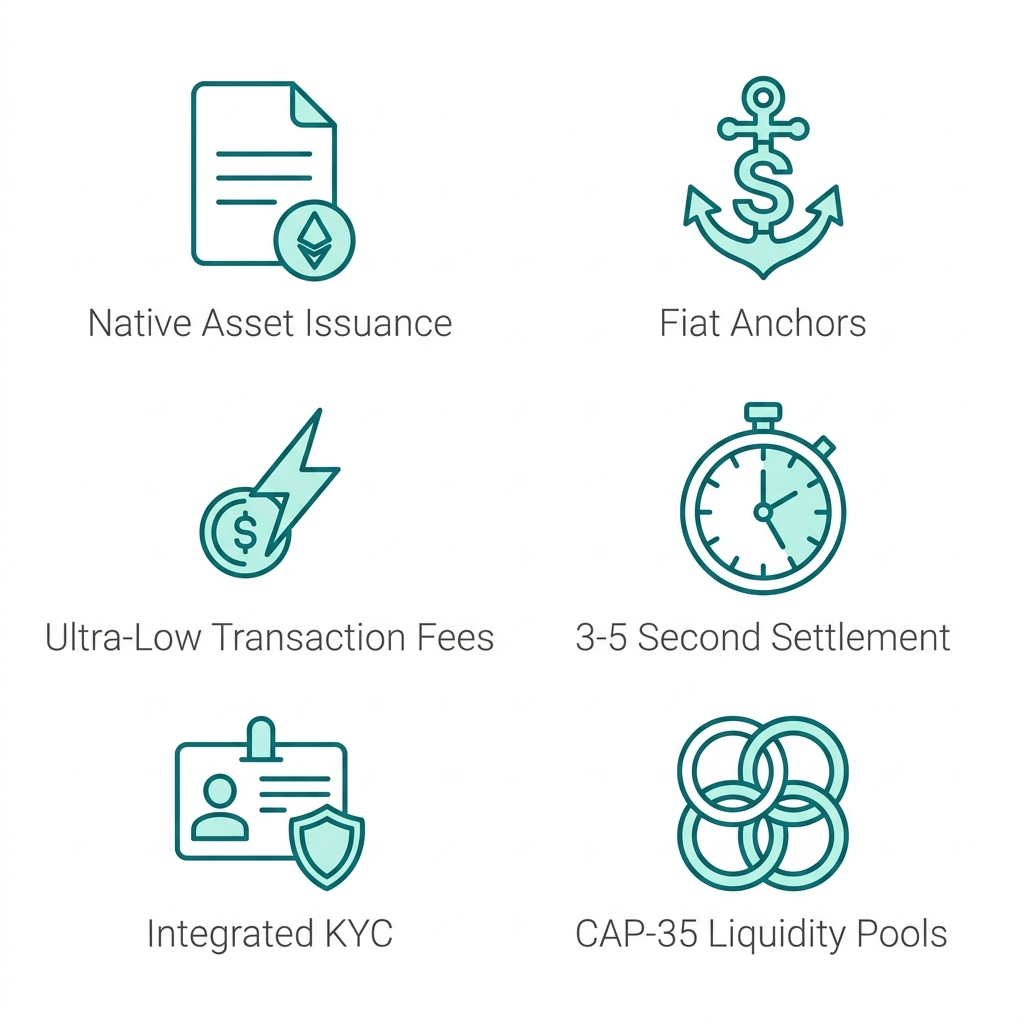
Native asset issuance makes it possible for projects to turn something like carbon credits into tokens that can be tracked on ledgers designed specifically for these use cases. Integrated KYC flows through licensed anchors eliminate the need for separate compliance middleware. Additionally, CAP-35 liquidity pools enable automated market making directly between two assets within their own blockchain environment.
Pros & Cons
Pros:
- Predictable, very low transaction costs suited to settlement at scale
- Fast deterministic finality without probabilistic confirmation delays
- Built-in compliance path through regulated anchors rather than bolt-on solutions
Cons:
- Smaller DeFi ecosystem limits composability compared to general-purpose chains
Best For
Stellar suits projects that are looking for settlement-centric tokenization, require on-chain value to move in tandem with fiat currency payments, have cross-border settlement as their driving force, and integrate with existing banking infrastructure. According to the INATBA report, it would make most sense in cases of regulated stablecoins and fractional assets.
Optimism
Optimism is an Ethereum Layer 2 scaling solution that uses optimistic rollups to execute transactions off-chain while inheriting mainnet security.
Overview
Optimism achieves full EVM equivalence, enabling Ethereum smart contracts to deploy without modification. In addition, Optimism will maintain the tried-and-true security of Ethereum itself. By compressing transactions, we can reduce fee costs without sacrificing decentralization. Optimism will roll-up transaction batches in order to post them to Ethereum for eventual confirmation.
Features
Block times are about two seconds, with fees a fraction of Ethereum mainnet. EVM equivalence lets existing Solidity code run unchanged, as I’ve confirmed through direct deployment. Optimism’s Superchain ecosystem connects projects within the rollup stack.
Pricing
The cost for gas is much less because we have call data compression and also batch all operations together for better efficiency. Optimism publishes current gas prices at https://gas.optimism.io.
Pros & Cons
Optimism is a cheaper, faster way to transact while still being secure like Ethereum, which makes it good for custodian services. INATBA’s report notes that tokenization enables automated compliance and 24/7 market access, advantages that Optimism can scale efficiently. Optimistic rollups have a seven-day challenge period if you want to withdraw funds, and there are some institutional-grade custody and KYC workflows out now but they're not yet fully integrated.
Best For
Scalable asset tokenization projects requiring Ethereum-level security and lower costs will find Optimism a strong fit. Projects with off-chain custody agents and modular KYC benefit from EVM compatibility and growing DeFi options.
Let’s take a step back here. These characteristics position Optimism as a compelling choice, but how does that compare to the rest out there.
Comparing Tokenization Platforms
Optimism’s architecture as an Ethereum Layer-2 roll-up lowers transaction costs while inheriting Ethereum’s security, making it a strong choice for high-throughput tokenization of physical assets. Choosing the right real world asset tokenization platform, however, involves weighing more than just scalability. A tokenization report notes that the benefits of real world asset tokenization—including 24/7 market access and automated compliance—depend on a platform’s ability to enforce those properties on-chain.
While Ethereum provides the deepest ecosystem and most generalized form of smart contracts available, high gas prices often put a roadblock on tokenizing low value assets. With Stellar’s native support for assets via native asset control capabilities such as clawbacks and authorization flags in addition to near zero transaction cost, this makes it fit for regulated asset issuing apps. Optimism gives teams full EVM compatibility with huge fee reduction, allowing them to reuse Ethereum tooling with fewer bottlenecks.
My approach prioritizes the technical requirements of each project. For a client that must meet strict regulatory obligations, I lean toward Stellar’s built-in compliance features. When broad DeFi interoperability is essential, I build on Ethereum or Optimism. In every case, I select the chain that aligns with the project’s compliance needs and performance targets. Working with an engineer who understands these trade-offs and can implement on Ethereum, Stellar, or Optimism turns a platform choice into a concrete, deployable outcome.
Your Engineering Partner for Production-Ready Tokenization
After evaluating tokenization platforms, it became clear that picking the infrastructure was just one side of the coin. Actually bringing projects to market demands a partner who owns the complete engineering stack, from the smart-contract code all the way up to secure deployment pipelines. I've led projects.
The association's tokenization infrastructure report also emphasizes that production ready systems need to be capable of supporting 24/7 market activity and automated compliance, all without relying on any specific technology stack. The demand for a set of harmonised rulesets to govern tokenisation across jurisdictions points towards the requirement to engineer adaptable systems from smart contract inception right up until the moment they get deployed. Having that full-stack experience under my belt, I have shipped audited mainnet deployments to Stellar and Optimism and production backend services at scale. Everything stated here can be checked out via their respective repos or by looking at live deployments.
If your team is developing real-world asset tokenization infrastructure, I’m available to discuss how we can take your concept through architecture, testing, and mainnet deployment.
Discuss Your Tokenization Project
You've now seen how Ethereum, Stellar, and Optimism each offer distinct advantages for real-world asset tokenization infrastructure. Choosing the right platform is important, but bringing a tokenization project to production requires deep technical expertise across smart contracts, compliance, and deployment. As a full-stack lead developer, I build the entire system—contracts, services, pipelines—so you can launch confidently. My portfolio includes DeFi protocols on Stellar and Optimism, and identity verification systems at Consensys. Let's discuss how these skills can turn your tokenization concept into a secure, scalable reality. Visit my portfolio to explore case studies and reach out to start the conversation.
Discuss Your Tokenization Project