AI Agent Development Cost: 2026 Comparison and Pricing Guide
Table of Contents
Understanding AI Agent Development Costs and Planning
Understanding AI agent development costs in 2026 requires looking beyond the initial build price—rule-based agents start at $5,000 to $20,000 while complex multi-agent systems exceed $400,000, and the build itself represents only 25-35% of the three-year total cost of ownership. As lead developer, I evaluate every project through this longer lens because ongoing LLM token usage, infrastructure, and maintenance often surpass the upfront investment.
While off-the-shelf solutions provide cost benefits for small projects, they may be misleading regarding their long term value as resolution increases. Pricing per resolution for an AI system, which appears reasonable initially, might come to $23,760 annually if the application uses only 2,000 resolutions each month. Seat prices were not included. Many firms overlook two significant components of the budget: the effort required to clean up data and ensure its accuracy. Poorly prepared data has delayed launches by weeks.
Thorough planning is done well before writing any actual code for an AI agent, and it keeps the timeline aligned with budget realities. So in order to have good plans, we must understand what makes up each step involved with building one of those agents.
© 2026 Fernando Trouw
Prerequisites for Building an AI Agent
Having said all this, let's move on to what needs to be done now the cost picture is known. Litslink's 2026 industry analysis states that build costs amount to only around 25-35% of the TCO over three years. The other 65-75% is made up of ongoing operational expenditure which we can influence by proper preparation. I treat the following items as prerequisites.
Yet, when overlooked, they can derail both budgets and schedules; clean data avoids downstream rework. Agents should choose an orchestration protocol such as Agent2Agent (A2A) or the Model Context Protocol (MCP) early; it defines how the agent communicates and interoperates with other systems. Another component of durability requires the platform to survive a worker's failure to maintain the work flow states: Temporal was cited as such in the CIOPages orchestration report from 2026. This makes it critical for production environments. Also ensure that you have the needed backend infrastructural needs met in the form of API endpoints and hosting, Vector Stores.
Once there is no direct user input I proceed to setting up a policy for explicit consent from the user as well as individual agents' token budgeting. Every call into every tool must ask whether the end user consents and must cap that agent's token use. So you do not want to pay a bill because your token budget was too high. This will save costs and help secure tokens; if an agent is cut off mid-task, recovery tests ensure it can resume after a restart. With these preconditions met, the next step is to define what the agent does and how success criteria will look.
Step 1: Define Your AI Agent’s Purpose and Success Metrics
In my experience, the main reason why these AI agent efforts fail has been a fuzzy concept of what would qualify as success. My advice here: write a single sentence that tells the whole story, i.e., how you'll know if the AI system succeeds or fails at its job, for example “Automating customer onboarding verification.” Do NOT start with some grandiose aim such as "increase efficiency."
In addition, connect its goal to concrete KPIs (key performance indicators), which should have practical measurements for the enterprise in terms of profit loss, payback, cost per transaction, etc. Litslink provides figures related to the budget allocation for rules-based agents (about $5,000 - $20,000) and complex multibehavior agent-based systems over $400,000. In other words, tie up objectives to budgets. You are less likely to misjudge long-term maintenance costs or cause scope creep if you set realistic goals and KPIs when building artificial intelligence agents.
After identifying the purpose and establishing what metrics to track, you’ll be ready to choose the right compute resources, frameworks, and integrations to help get the job done on time, within budget.
Step 2: Plan the Architecture and Technology Stack
The architecture you choose — rule-based, multi-agent, or hybrid — directly dictates the agent’s capabilities and infrastructure needs. Translating a defined purpose into a working system starts with selecting an architecture pattern and a matching technology stack.
I map the purpose to an architecture pattern: rule-based for straightforward automation, multi-agent when complexity demands autonomous coordination. Industry data places multi-agent build costs above $80,000, while simple rule-based agents typically range from $5,000 to $20,000. Integration depth – linking to CRMs, ERPs and data pipelines – influences cost more than the language model choice, and data preparation is often underestimated.
On the stack side, I pick an agent framework like LangChain, a vector store such as pgvector for memory, and an LLM provider — API-based or self-hosted. Deployment infrastructure (cloud vs on-premise) influences scalability and ongoing operational costs. These decisions underpin the cost and timeline estimates that follow.
Step 3: Estimate Initial Build Costs and Timeline
Now that we have chosen our architecture and technology stack for our AI agent, let’s move on and make some educated guesses as to how much time and money it will take us to get up and running. To give you a better estimate in regards to AI agent software development costs, keep in mind that the initial cost of building the software accounts for only around 25%-35% of the total three year cost of ownership.
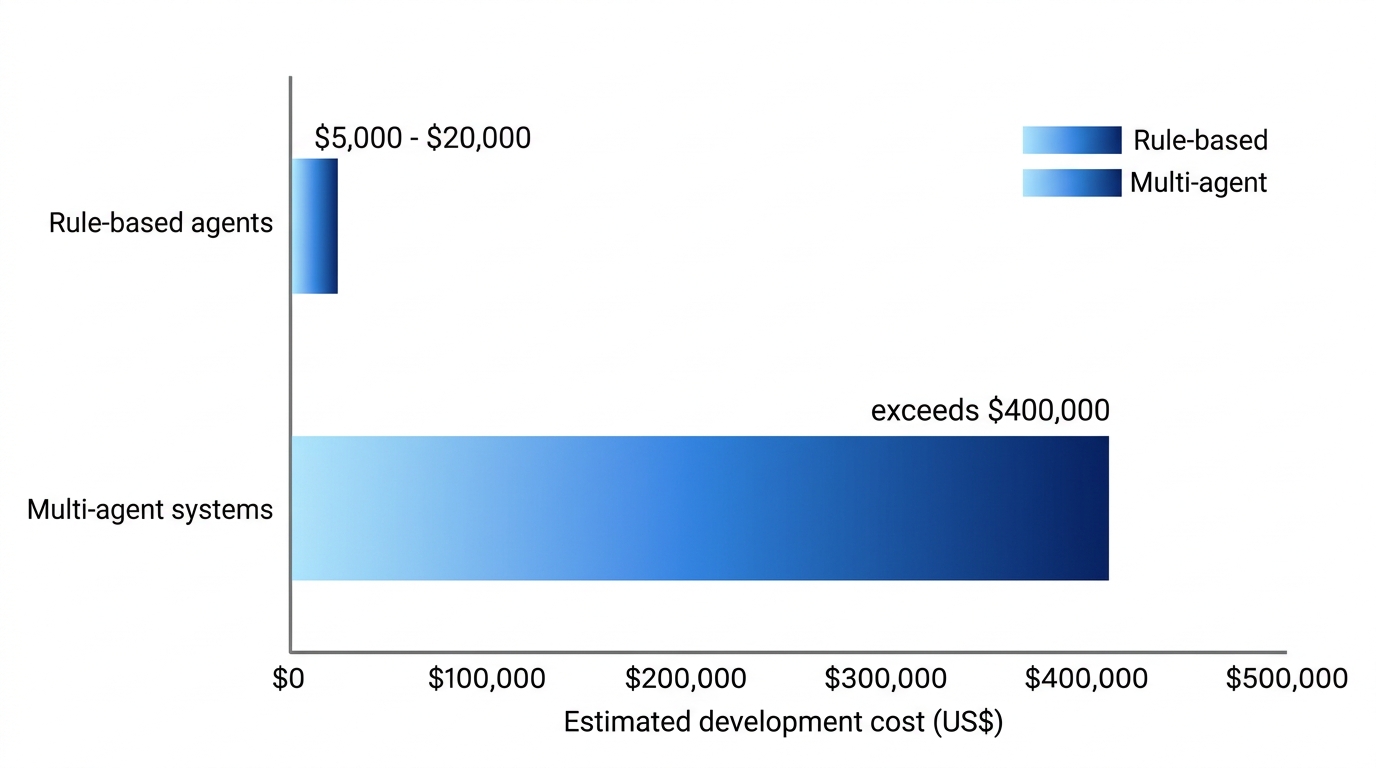
| Agent Type | Complexity | Estimated Cost Range | Key Use Cases |
|---|---|---|---|
| Rule-based agents | Low | $5,000–$20,000 | Simple automation (data routing, triage) |
| Custom chatbots | Medium | $20,000–$80,000 | Customer support, lead qualification |
| Multi-agent systems | High | $100,000–$400,000+ | Complex workflows (supply chain, enterprise orchestration) |
Timelines for development increase with project complexity; they typically take between 6-10 weeks per model-based agent. Often data preparation and quality assurance tasks tend to be forgotten budget lines.
Step 4: Design Data Pipelines and Integration Architecture
There may be two areas in AI agent development costs where projects succeed or fail: The design of data pipelines, and the architecture for integration. Often enough we tend to ignore them - and these omissions make all the difference between successfully completing the project on time, and blowing our budget out of the water. According to industry analysis, inadequate data readiness is a leading cause of budget overruns.
For production environments, it pays to be able to store state, allowing your workflows to be retried without losing any information in case something goes wrong during processing. This makes it easier for us to restore execution with minimal manual intervention and prevents costly data loss.
Integration complexity should take priority over anything else when discussing TCO, even model selection. I define agent-level token budgets and ask for users’ permission to execute tools, practices that curb unpredictable operational costs and maintain user trust.
With this infrastructure in hand, you can start coding and testing out your agents using well-defined interface patterns.
Step 5: Build and Test the Core Agent Logic
The bulk of the work now goes into writing the actual agent logic, with costs around this part varying from $5,000 to $20,000 for rule-based agents as per a comprehensive AI agent development cost analysis (2026 industry analysis), whereas multi-agent system implementations might run up to $400,000, even if building these consumes only 25 to 35 percent of the estimated three-year total cost of ownership.
Data preparation and quality assurance are frequently underestimated. Overlooking either can add weeks of rework and compromise the project's success.
During testing, we’re careful about how much money we spend, which is why we assign a maximum budget of tokens to each agent. CIOPages' 2026 orchestration report underscores this practice, and a token cap acts as a unit-economics guardrail, exposing wasteful calls before they inflate the monthly bill. Execution engines such as Temporal will persist the status of workflows even if there’s a failure, allowing retries without losing data. By April 2026, over 150 organizations had adopted the Agent2Agent protocol, so building with protocol-aware integrations future-proofs interoperability.
These practices surface token-usage patterns and failure-recovery costs, pointing to refinements.
Step 6: Implement Cost Reduction and Efficiency Measures
After building and testing the core agent logic, the immediate priority is to rein in costs and boost runtime efficiency before moving to production. Managing your AI agent development cost requires deliberate architectural and operational choices that keep spending in check without sacrificing reliability. Rule-based agents can cost as little as $5,000, while multi-agent enterprise systems often exceed $400,000—making the simplest viable architecture the most powerful cost-reduction lever.
CIO Pages recommends setting token budget per agent to control the ongoing LLM costs, which is best practice. Also, I lean on durable execution engines that can be used to retain workflow state in failure cases and to allow us to retry reliably, reducing expensive recovery overheads. The first build typically accounts for only 25–35% of TCO over three years, so I stay vigilant about hidden drains like data preparation, QA, and ongoing infrastructure maintenance. All these measures form the basis of lean & sustainable deployments.
Step 7: Deploy, Monitor, and Maintain Your AI Agent
Once all required steps have been taken to boost operational efficiency, the next measure is to implement and manage the agent that will help cut expenditure.
- I recommend deploying with a durable execution engine so workflows maintain state through failures and can retry reliably.
- Set per-agent token budgets and require explicit user consent before invoking tools to prevent unchecked usage.
- Enable tracing from day one; detailed traces expose performance lags and pinpoint cost drivers early.
- Account for data preparation and quality assurance in your maintenance plan — they are routinely underestimated and can skew timelines and budgets.
- Establish a maintenance rhythm: monitor token consumption, review consent logs, update protocols as agent ecosystems evolve, and benchmark costs against original estimates.
This means that even when you've done your homework there will often be things which turn out to have been completely unforeseen. I'll discuss some of the issues uncovered here in the next chapter.
Troubleshooting Common Challenges in AI Agent Development
There will be problems in deployment with an AI agent when you see that costs have gone up post operation, and there is less reliability than before launch. LITSLINK's 2026 analysis says they skip on data prep and quality checks because the former is expensive while the latter takes time. One suggestion was to set the budget for tokens per agent to keep per-interaction costs from going overboard.
According to CIO Pages, Durable Execution Engines provide the ability to recover from system crashes reliably. They allow storing a process's state when something bad happens and retry parts that failed without losing all work done up until then. Though off-the-shelf tools might seem cheaper initially, per-resolution pricing often becomes more expensive at high volumes, while a custom solution becomes more predictable once infrastructure is in place.
| Approach | Upfront Cost | Per-Interaction Cost at Scale | Maintenance Burden | Flexibility |
|---|---|---|---|---|
| Build your own | $5,000 to over $400,000 depending on complexity | More predictable once infrastructure is in place | Ongoing monitoring, updates, and data quality management | Full control over features and integration |
| Buy off-the-shelf | Lower and often subscription-based | Can rise sharply with per-resolution pricing | Reduced effort but may involve vendor lock-in | Less flexibility but faster deployment |
Build your own systems require stronger maintenance discipline but offer full control and predictable unit economics at high volume. Off-the-shelf products reduce maintenance effort, yet vendor lock-in and per-resolution fees can erode early savings. Understanding these differences helps teams align their choice with long-term operating requirements.
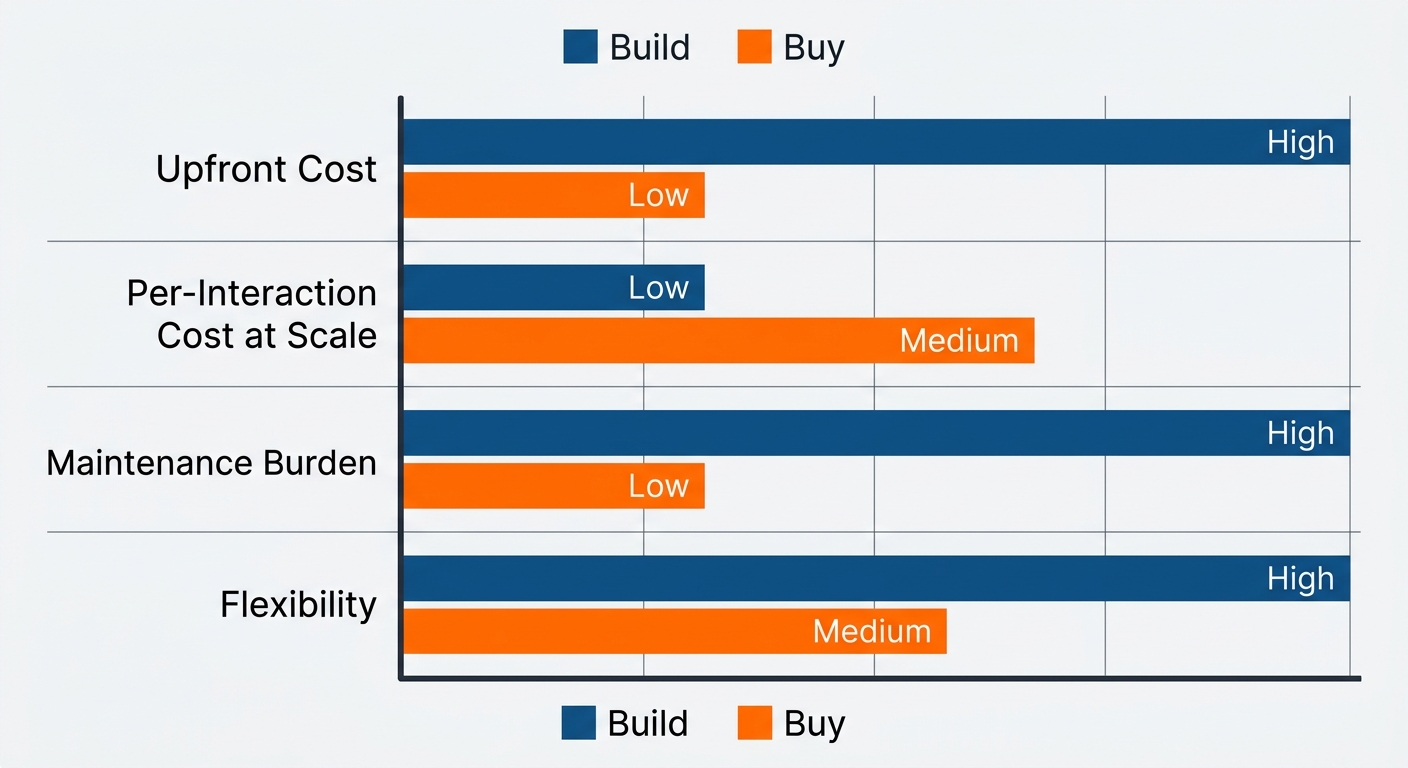
Selecting whether to build or buy is ultimately a strategic decision about cost predictability and product control.
Making a Strategic Decision for AI Agent Development
AI Agent Development Cost: When you're considering how much it costs to develop AI agents, the cost to initially create an AI agent may be only one portion of your overall expense. Rule-based agents usually range from $5,000 to $20,000, whereas Multi-agent enterprise solutions might cost more than $400,000. Although off-the-shelf solutions appear cheap, this price doesn't include per-resolution costs, which can become a large part of total cost over time. For example, a commercial AI tool priced at $0.99 per resolution will cost around $23,000 annually if there were only 2,000 interactions each month. Costing and Quality Assurance of data used as training sets are frequently over looked parts of project planning which take their toll on budget and timeline.
I rely only on claims verifiable from repositories or live sites.
The majority of that three-year cost is LLMs and infrastructure costs. I help teams think through those costs over time as well as model TCO from discovery all the way into governance, making sure the solution fits their volume, integration depth, and compliance needs. If you're interested in doing some work around this, I can talk with you about your project and figure out how much actual investment would be required prior to making any commitments.
Bring Your AI Agent to Life
You've now explored the complete landscape of AI agent development costs, from simple rule-based agents to complex multi-agent systems. The seven-step framework laid out in this guide gives you a clear path from defining your agent's purpose all the way through deployment and cost optimization. With the complexities of data preparation, architecture planning, and ongoing monitoring, turning your idea into a reliable custom AI agent requires a partner who understands the full picture. Fernando Trouw’s deep experience building AI pipelines and backend infrastructure for production platforms like SEOLocal ensures your agent will be both powerful and cost-efficient. His portfolio documents delivered scalable AI systems and provides contact information for project inquiries. Your next intelligent agent is closer than you think.